You, and Your Loved One,
ARE THE target
An online resource to shield your family and friends from International Crime Organizations and local fraud criminals
This three-section guide is here to help you Prevent these attacks, walk you through critical and time-sensitive Triage steps to take IF you or your loved one become involved in a scam, as well as help you Take Back Control of your financial and emotional life once the initial crisis has been dealt with.

Why this guide is important:
What are you and your loved ones up against?
Highly sophisticated and highly organized criminals around the world (referred to as International Crime Organizations) specifically targeting people in the U.S. of all ages…targeting you and those you care about.
What are International Crime Organizations?
They are NOT simply con artists or swindlers of
simpler times, instead International Crime
Organizations are often organized and sponsored
by foreign governments and ‘staffed’ with thousands
of people. These crimes can include various forms
of online or phone scams, data theft, and other
fraudulent activities. Many who are victimized
believe that the person they are communicating
with is local or within the US, even though most of
the criminals are located overseas. Criminals are
barely just starting to use AI tools to impersonate
and deceive - meaning this problem is about to get
much, much worse.
Scams ruin lives. The financial, legal and emotional toll from scams can ruin victims’ lives, sometimes leading to death by suicide. Scams should be thought of as Financial Violence.
Let’s simplify and get to the core of what’s going on here: Almost all Scams are a form of Imposter Fraud (also known as ‘Social Engineering’), which simply means that a criminal or criminal group pretends to be someone else to get YOU to take actions immediately that allow them to steal your money or information.
Preview the Guide
Prevention Highlights
-
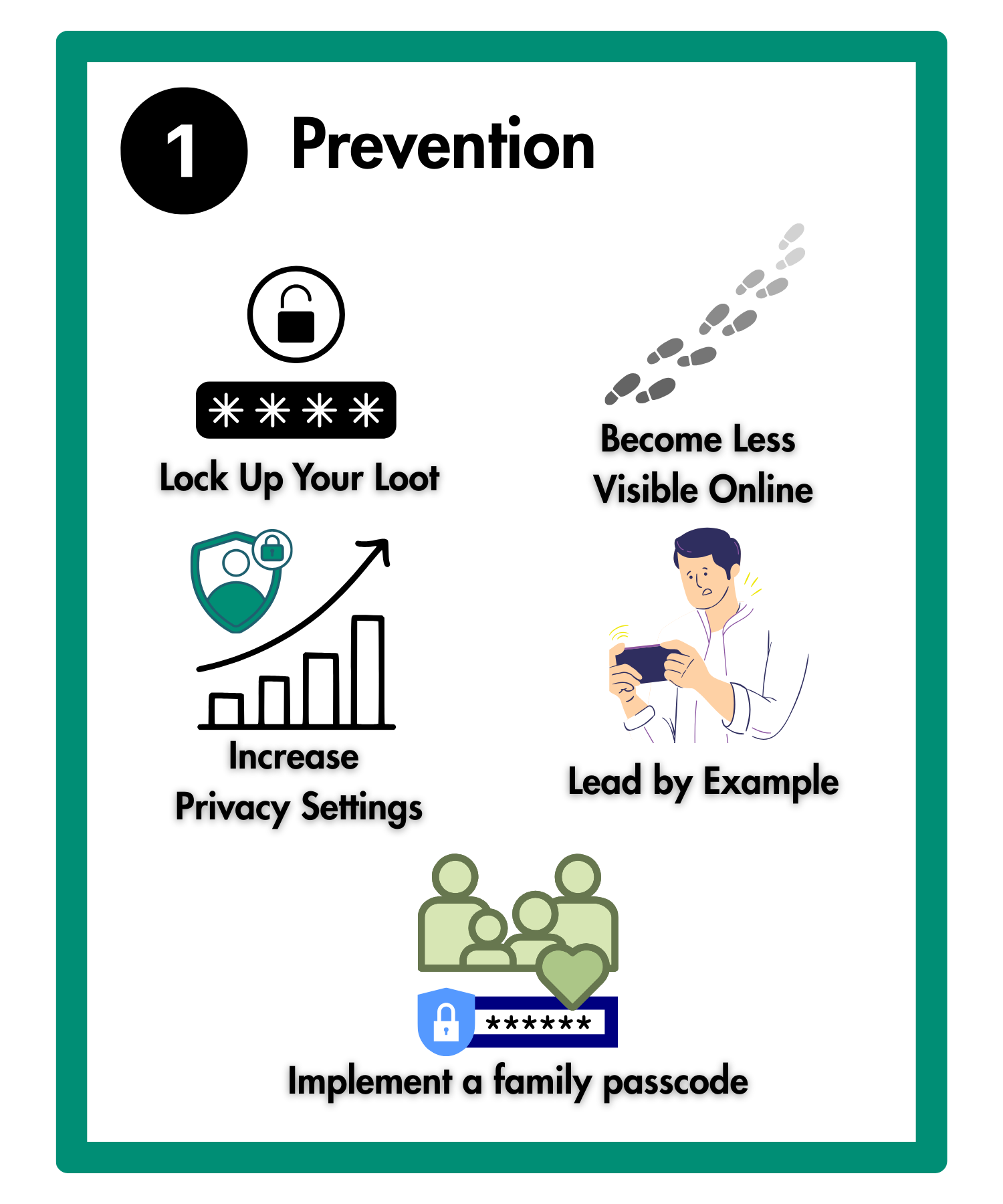
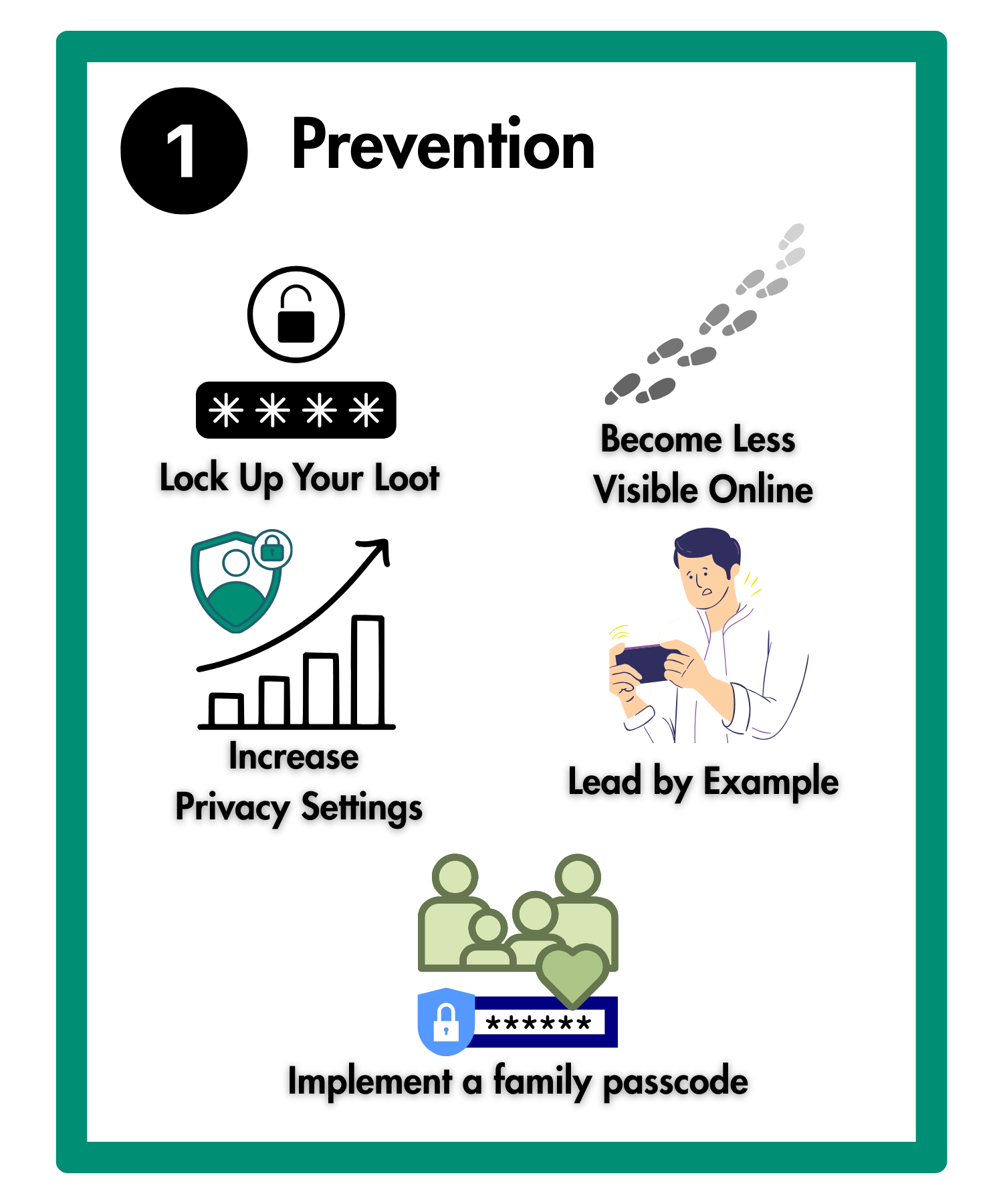
Separate and protect ‘Nest Egg’ assets (cash reserve/investment accounts) from the account(s) used to pay everyday expenses (transactional accounts)
Set up Alerts (transaction-level / balance level / daily or weekly alerts, etc.) to go to owner + the Trusted Contact
Turn on 2FA - Ensure 2FA and any other security measures offered
Set up Trusted Contacts for Brokerage / Bank Accounts
-
Purge: Minimize the number of endpoint threat surfaces by Inventorying All Online Accounts / Apps including financial, retail, social media, email, direct communication (e.g. What’s App), online games, etc.
Close unused accounts
Delete unused apps (both from phone and cloud backup)
Increase privacy settings and reduce personal information shared for the individual apps still in use
Get ‘less social’ - Perform Social Media Audit and Clean Up
Clean up your contacts by removing anyone you don’t personally know — including celebrities — and those you rarely interact with (remember: ‘your friend’s friend is NOT necessarily your friend’)
Make any sensitive information or data (e.g. marital status, town, vacation status, recent death in family, etc.) of user profile private, delete any personally identifiable info not required
Consider deleting photos / posts that reveal sensitive info, or clues for a fraudster (pics of minors, major life events, location of home, school, activities etc, etc.)
Increase privacy settings on everything, knowing that these sites often ‘hide’ privacy options, so there may be several settings you have to adjust.
Start Fresh: Out with the old and in with the new:
Email : Start fresh, and have two email accounts:
Account #1: Important items and people (only given to your banks, medical providers, utilities, social security and other benefit programs, family, friends, and business associates, etc.)
Account #2: Everything Else: To use on online shopping sites, social media, online gaming, etc.
Eventually delete the legacy email account, once you are sure that your new ‘Important items and people’ email address has been updated with all of your providers, financial institutions, and circle of family and friends
Usernames : Start fresh, particularly on accounts of monetary value:
Replace old usernames (particularly if they contain actual name or birthdate info)
Become ‘more invisible’ online
Remove Personal Data Online: Use Aura or Delete Me and other data removal services
Social Media: In some cases it may make sense to start fresh, deleting legacy user handles / names / accounts and re-enroll using an alias that does not reveal one’s true Identity. Then, very selectively, add back only trusted individuals to your network.
-
Increase privacy settings and reduce personal information shared for the social media and individual apps still in use.
Each site/app has its own unique instructions on how to manage/modify privacy settings. If you need further instruction, try a search engine request such as, ‘how can I increase my privacy level on What’s App?’, etc.)
-
These key prevention actions are NOT just for seniors, people of all ages are vulnerable and should be utilizing these measures. You can use this fact as an opportunity to make this a ‘family activity,’ securing yourself and your family / friends at the same time, leaving no one feeling singled out because of age or ability.
-
Implement a Verbal Passcode (or ‘family phrase’) for Family / Friend Circles
A verbal family passcode is a simple secret word or phrase your family agrees on ahead of time. You only use it in situations where you need to quickly confirm that an urgent message or request (via phone call or text) is actually coming from a real family member — not a scammer, impersonator, or AI‑generated voice. Remember, never send this code in an email or text as it might be discovered by the criminal.

Click image below for more info
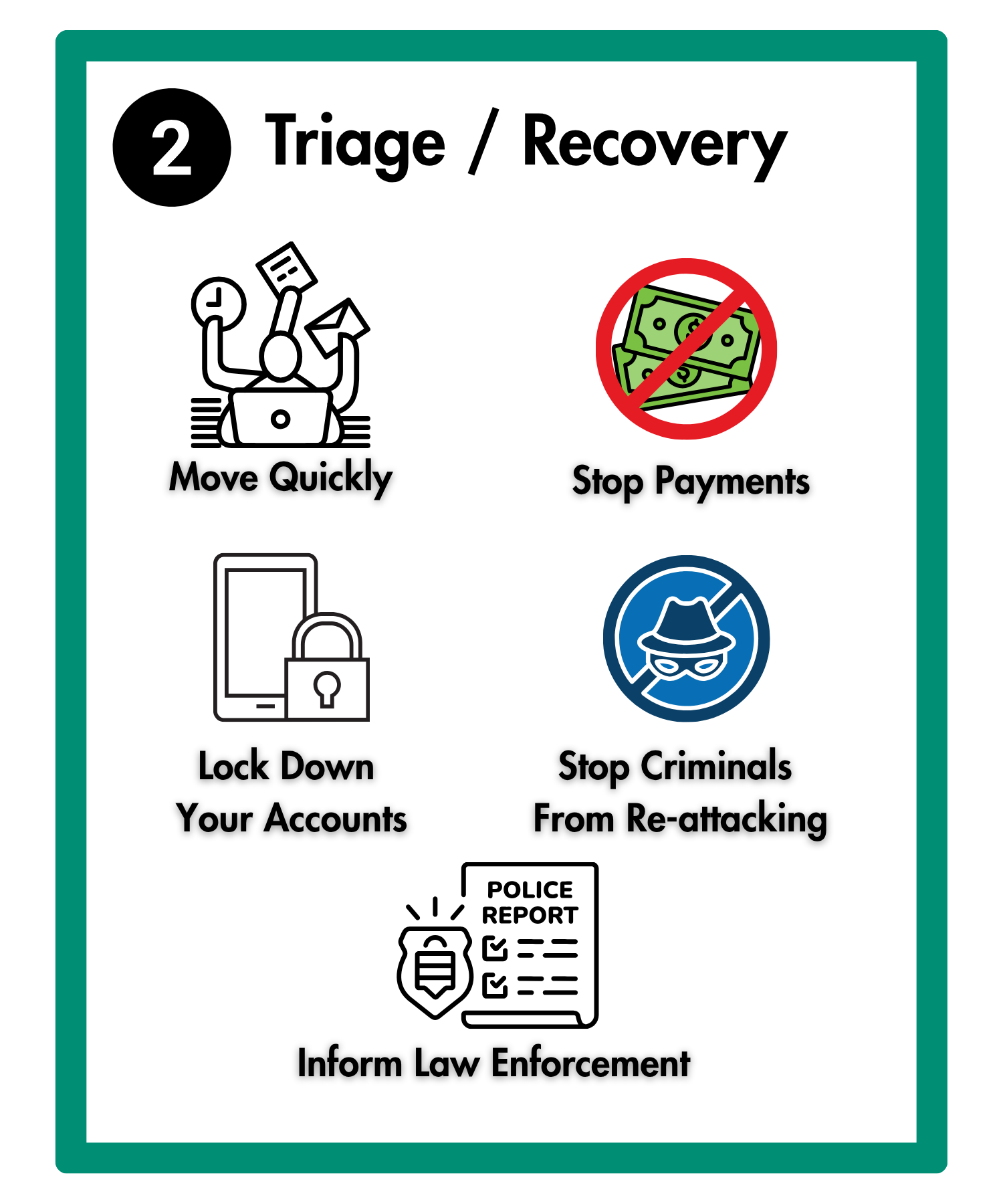
Triage / Recovery Highlights
-
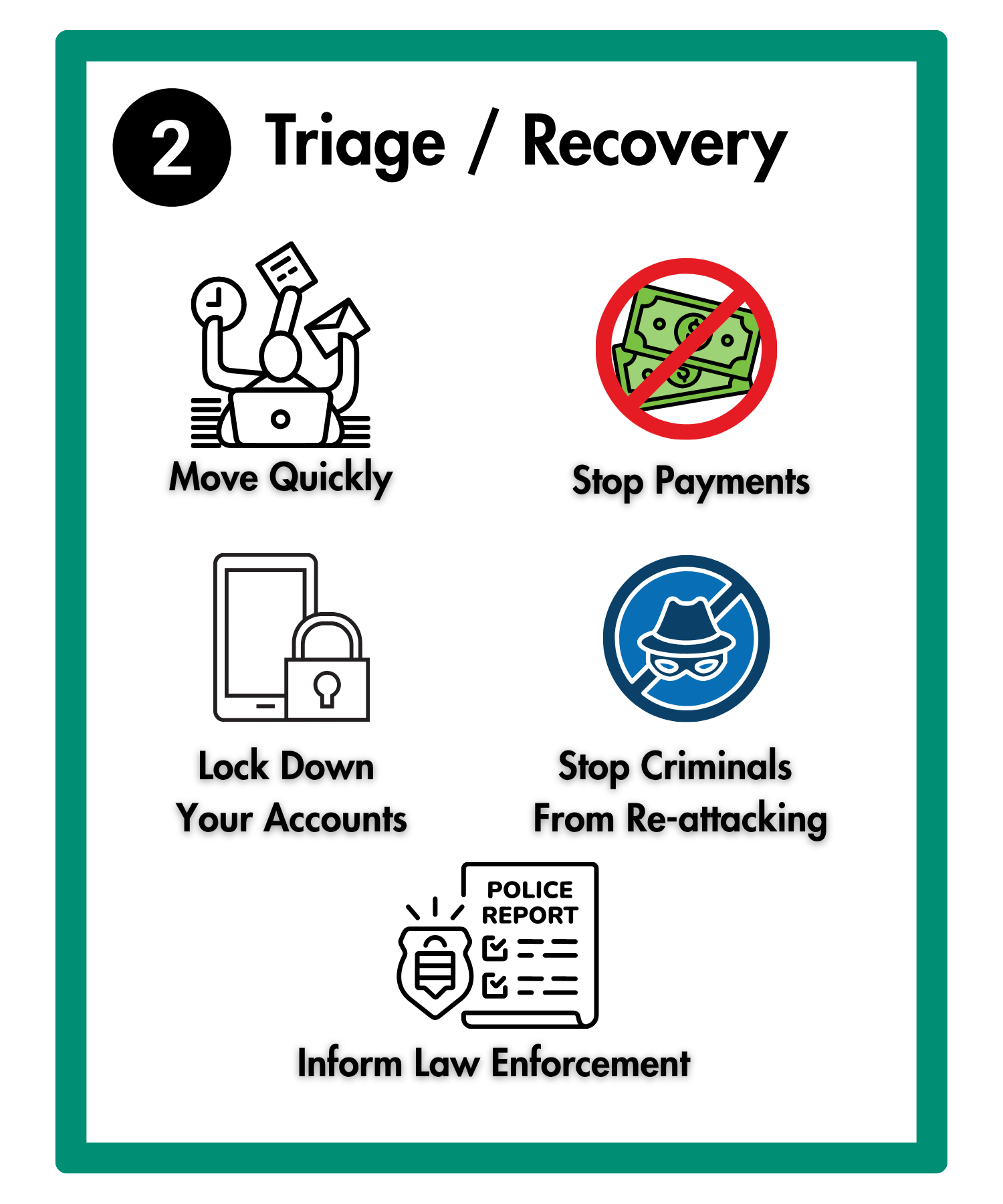
Acting IMMEDIATELY is critical to stop the financial hemorrhaging, and if hoping to recover any money
-
Urge efforts to stop payments ASAP.
Prevent any future victimization — social security, bank accounts, etc.
Refer to Table 1
-
Place a freeze on credit and monitor credit reports weekly
Setup Transaction Alerts on all accounts
Contact financial intitutions to put fraud alert warnings on all accounts
-
Stop ALL contact if the person victimized is willing.
When a loved one resists family warnings and sides with the scammer, the initial focus should be on cutting off the financial supply. Addressing the communication with the scammer should be the subsequent step.
If your loved one cannot be convinced and you need to step in, more forceable actions are required. See Prevention Section 1C Additional Measures for Severe Situations for more information.
-
File the IC3 (FBI Report) and then contact your local law enforcement agency, providing them a copy of the report
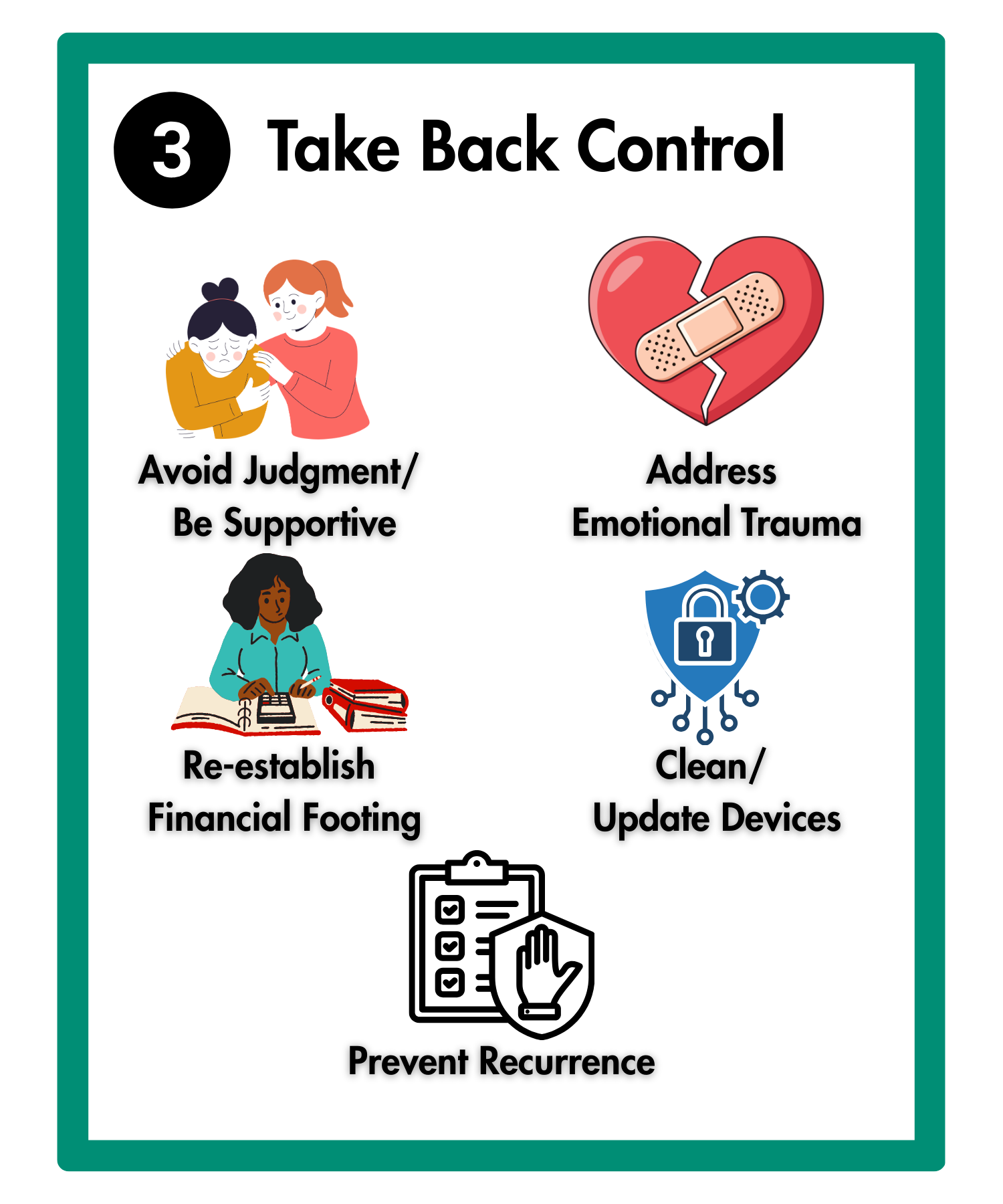
Take Back Control Highlights
-
Continue to listen without judgment
Encourage professional help
Stay involved
-
Instead of showing frustration with your loved one and lecturing, it’s important to realize that they are a victim experiencing trauma. Talk it out and be gentle with the person.
-
Please see the Re-establish Financial Footing section for specific instructions based on account types.
-
Call in a technical resource to clean the device (e.g. Geek Squad at Best Buy or someone trusted in your community.)
Note: IF the device is really old, consider getting a new device, it may be cheaper than trying to remedy the old device.
-
DO NOT mention the incident on social media AND be wary of anyone reaching out on social media to you to ‘help’ you resolve your issue (e.g. ‘attorneys,’ credit services, etc.) - they are very likely scammers, too!
DO NOT engage with any company touting themselves as a ‘recovery company’ - these are not legitimate organizations.
BE WARY of anyone who may be impersonating law enforcement (local or federal such as the FBI) promising to trace or recover money- for a fee or various costs.
For a full list of suggestions on how to prevent revictimization, please see “Moment-of-Truth Instructions for the Senior”